
When we talk about home, what comes to mind? You probably imagine a permanent home, with traditional rooms that meet basic needs. However, the reality of housing is much more complex and plural.
In an ever-changing world, with different cultures, economic and social realities, housing can manifest itself in countless ways. She is more than a roof and four walls, but rather an extension of who we are and the way we relate to the space around us.
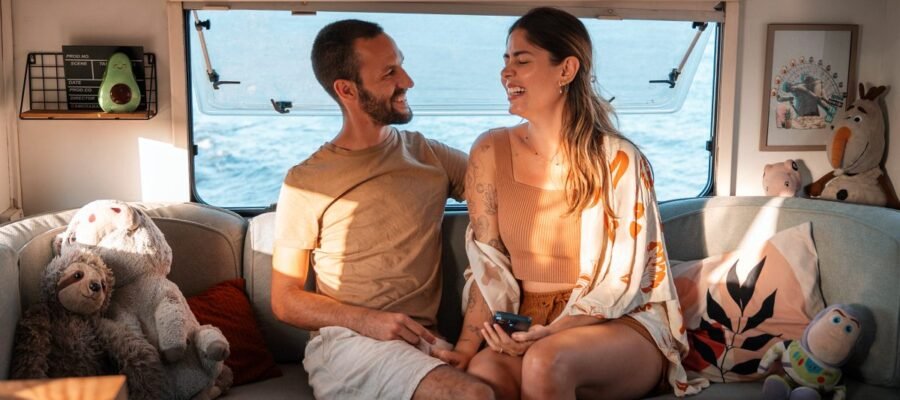
In this text we talk a little about the plurality of the concept of housing and how it is seen by different people around the world. To illustrate the topic, we invite Thaís and Bruno, from the profile «Where are we?»to talk about what it means to live in a home considered non-traditional. The couple tells us the main sensations, advantages and challenges of having undertaken one camper in Europe like lar.
To begin with, what is housing?
Home is the space in which people live, a a place that offers shelter, security and conditions for development of personal, family and social life. It goes beyond being simply a physical construction: it is, primarily, a fundamental human right guaranteed by the Constitution and the UN.
In the social and urban context, housing is also directly linked to the right to the city and quality of life, reflecting issues such as accessibility, infrastructure, community integration and proximity to essential services, such as healthcare, education and transport.
The concept of «living» and the relationship of people with the place where they live
The act of «living» goes beyond the function of covering and representing the way people see the space they occupy. There are different ways of conceiving living, and these conceptions vary depending on lifestyles and individual needs.
There are different ways of seeing and conceiving the concept of living:
- Nest Style: For many people, home is a space of comfort and refuge, where they seek tranquility and rest. These homes generally have a more comfortable and welcoming configuration, with spaces that favor well-being and relaxation.
- Functional style: In this style the house is seen in a practical way, with spaces optimized and designed to facilitate daily activities. Functional style homes tend to be minimalist and make the most of the functionality of the rooms.
- Sociable style: For those who love interacting and receiving visitors, the house is a space for socialization. Environments such as living areas, integrated kitchens and balconies stand out for facilitating social interactions.
- Style Status: housing can also be seen as a representation of personal achievement. In this case, the house reflects the status and social position of the resident, with emphasis on the use of noble materials, sophisticated design and elements that indicate exclusivity.
- Nomadic style: With the rise of global mobility and technologies that enable remote working, the digital nomad lifestyle has gained traction. For these people, living means being in constant motion, whether in a camper, on a boat or in temporary spaces around the world.
According to Thaís and Bruno, for example, people living in unconventional housing are looking for live experiences that would not be possible in a traditional home: “they teach the simple, resilience, dealing with the unexpected, respecting spaces and live with less and still feel complete“For the couple, the concept of living «It’s totally about the security that the place can convey. For many people, living on the move can be a challenge, but in our case it makes us even more alive – and being together makes the feeling of home exist.»
Discover some of the different forms of accommodation around the world
Permanent housing is the most common type, present in urban and rural areas. Houses and apartments, for example, follow a traditional structure with spaces dedicated to daily functions, such as kitchens, living rooms and bedrooms.
However, when we expand the concept of housing beyond the conventional model, we can observe a diversity of ways of living. Some are the result of specific cultural contexts, while others arise from economic and social circumstances.
Asylum
Residences designed for elderly people who require special care and, often, full-time support. These homes generally offer a collective structure, with common spaces and medical care, as well as promoting social interaction between residents.
Boat and houseboat
In different parts of the world, communities choose to live on boats. In the Amazon, for example, it is common for families to live on boats that travel along the region’s rivers. In cities like Amsterdam and Sausalito, USA, houseboats have become attractive housing alternatives.
Circus
Circus families lead an itinerant life and their accommodation reflects this mobility. Living in caravans or tents, these professionals are constantly on the move, which requires a living structure that can be easily transported and set up in different locations.
Container
In response to the housing crisis and the search for sustainable solutions, container homes have gained ground as they are cheap, quick to assemble and easy to adapt to different climates. Cities like London and Tokyo already use shipping containers as a solution to housing students and low-income people.
Favela

Favelas are makeshift homes, often built without adequate urban planning, which are home to millions of people around the world. In Brazil they are widely known and reflect a mixture of self-sufficiency and precariousness. Despite the difficult conditions, many favelas have become centers of culture and art.
A needle
Igloos are the traditional homes of the Eskimo people in the Arctic. Made from compacted blocks of ice, they are designed to withstand extreme temperatures and provide an efficient and functional space to survive in freezing environments.
Student accommodation
Student housing is aimed at a young audience, generally university students, who are looking for a temporary and practical solution live while they study. They can be shared dormitories, republics or even small apartments close to universities.
Quilombola
Quilombola communities are made up of descendants of African slaves who escaped and created their own settlements. Its houses, located in rural areas, respect traditions and integrate with the environment, with construction techniques that use local and sustainable materials.
Campers
Increasingly popular, especially among digital nomads and long-distance travelers, the camper offers the freedom of having a home on wheels. Equipped with the basic services of a conventional house, this type of accommodation allows people to live in different places without sacrificing comfort.
Thaís and Bruno, from the profile “Ande a Gente Tá?”they are great examples of how living in a non-traditional home can be rewarding.
In an interview with Casoca, the couple, who has been living in a camper in Europe since 2022he stated that, among the greatest difficulties, that logistics is in first place: “In a permanent home you don’t have to worry about the amount of water you will use to shower or wash dishes. In a camper you always have to think about details such as water storage and porta potti (toilet) disposal.”
But obviously the advantages stand out, especially for those with a stronger sense of adventure: “have the world as your backyardbeing able to feel at home anywhere and visit countries that would be practically impossible economically (we have already traveled to almost all the countries in Europe). Furthermore, we love the unpredictability that this life offers, as in practice every day we experience new things and different experiences, and this is very rewarding.»
How can architects and designers conceive the different forms of living?
Given the diversity of housing forms, architects and designers are faced with the challenge of designing spaces that satisfy different lifestyles and needs. Creating homes that promote comfort, functionality and a sense of belonging is essential. But how to transform these houses into a real home?
- Context adaptation: It is important to consider the cultural and social context in which the project will be inserted. Solutions that work in one place may not make sense in another, which is why it is worth studying the particularities of the place and the people who will live there.
- Flexibility and customization: Offering flexible solutions that can be customized to residents’ preferences and needs is a differentiator. Adaptable and modular spaces that allow for different configurations are essential, especially in compact or temporary accommodation.
- Sustainability: An important trend is projects that respect the environment, using local and recycled materials. In addition to reducing environmental impact, these constructions tend to be more economical and efficient.
- Inclusive Design: When designing it is essential to think about accessibility and inclusion, creating spaces that can be inhabited by people of different ages, physical abilities and special needs.
- Identity Creation: To transform a space into a home it is important to bring elements that reflect the identity of the residents. The use of colors, materials and objects that carry memories and affections can make the difference.
The plurality of accommodation is a reflection of human diversity, and the role of architects and designers is to welcome this diversity, creating spaces that, regardless of format, convey the feeling of home.
Speaking of Thaís and Bruno, from the profile “Aonde a Gente Tá?”
Thaís and Bruno are a couple passionate about travel. Since the beginning of their relationship in 2017, they have been looking for ways to experience less the common routine and more the unusual itineraries that life can offer.
After doing an exchange in Ireland and backpacking through Asia, the two figured it out a camper van could be a great option for what they were looking for – after all, they would have the convenience of a home on wheels and the experience of traveling without missing a place to return to.
In June 2022, the couple decided to leave traditional life in Ireland live by traveling around Europe aboard a Fiat Ducato 1998 (or “Duke”, to those close to you). After some repairs and adjustments in the first month, the feeling of home began to exist, quickly and without many complications.

Today Thaís and Bruno record their adventures on their profile «Where are we?» NO Instagram, YouTube And TikTok. In total, the couple has more than 128,000 followers and shares everything they do while living in an RV.

About Casoca
Comments